
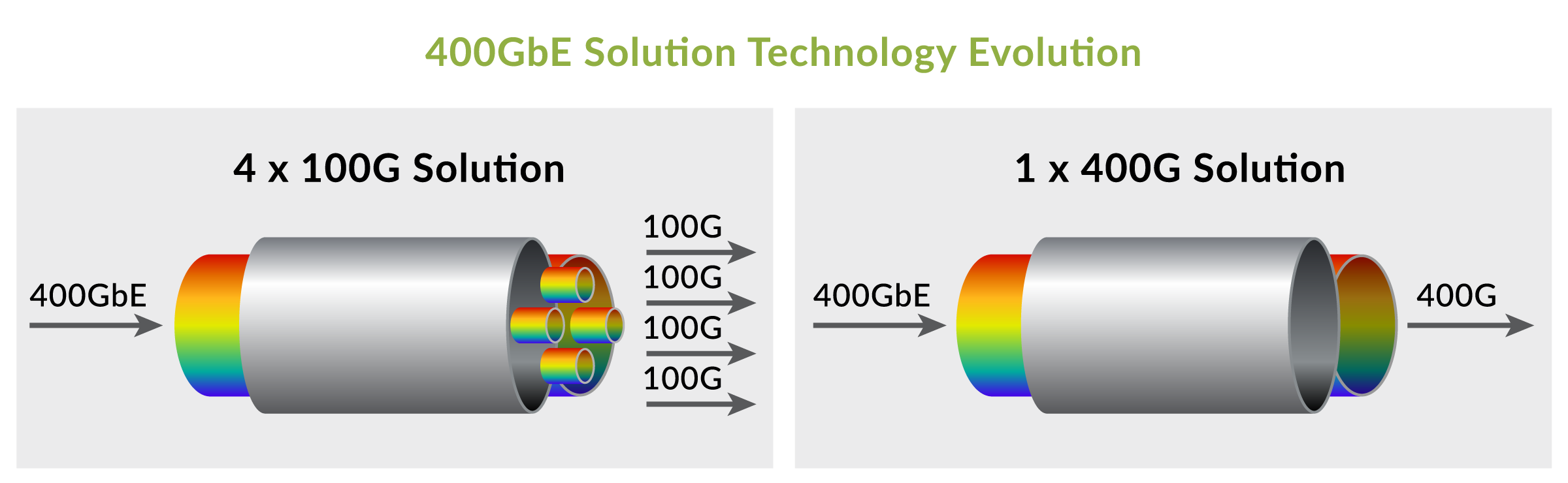
The 400G all-optical network, as a generational transformative technology for the next development cycle of optical transmission networks, serves as the all-optical foundation for the efficient circulation of computing power in the future. Recently, China Mobile held a press conference in Beijing to announce the "First Provincial 400G OTN Backbone Network Link and Application Release," declaring the official commercial use of the world's first 400G all-optical provincial (Beijing to Inner Mongolia) backbone network, signifying the formal start of the commercial era for 400G OTN (Optical Transport Network).
China's Industrial Strength Leads the 400G Backbone Network Technology Path
Modulation formats are one of the key technologies for ultra-high-speed transmission, directly determining the system's technological direction. Converging various competitive modulation formats is a primary issue that needs to be addressed for the development of 400G technology. From 2018 to 2021, the domestic industry successively introduced technical routes for single-channel 400G transmission using 16QAM (Quadrature Amplitude Modulation) and 16QAM-PCS (Probabilistic Shaping Technology). After years of effort by the industry, the B2B OSNR (Optical Signal-to-Noise Ratio) tolerance of 400G 16AM-PCS has reached 17.5dB, meeting the needs of classic commercial scenarios based on G.652.D fiber and supporting 1000km point-to-point transmission and 720km span-by-span OXC (Optical Cross-Connect) network transmission. However, given China's vast territory and the requirements for ultra-long distance and ultra-low latency for the "East Data West Computing" project, it is necessary to consider OXC's all-optical networking and transmission capabilities over 1500km. Additionally, for spans introducing optical layer protection, an extra insertion loss of about 4.5dB must be added. The 400G16QAM-PCS technology cannot adequately meet the actual needs of China's long-distance backbone network transmission. Therefore, China Mobile has determined the backbone 400G technology path to use QPSK modulation, 130GBd high-baud-rate optical devices, and "C6T+L6T" wide-spectrum high-speed optical communication technology.
In the 100G era, the signal baud rate was about 30GBd, which could achieve an 80-wave system based on the C 4T band with a 50GHz channel spacing. For 400GQPSK, the signal baud rate is increased fourfold to about 130GBd, with a channel spacing of 150GHz, requiring the 80-wave 400G QPSK system to expand to the 12THz "C6T+L6T" band. The application of 400G QPSK cannot be separated from breakthroughs in ultra-high baud rates and ultra-wide spectra, and due to the high technical difficulty and demanding requirements for chips and devices, the industry initially had reservations about investing in end-to-end QPSK R&D. To promote the development of 400G QPSK technology, China Mobile has driven the industry to tackle challenges in ultra-high baud rates, including high-speed optical fiber cores, high-performance DSP algorithms, and advanced chip manufacturing processes, collectively pushing the signal baud rate from 30GBd to 130GBd to meet the high-performance transmission needs of 400G QPSK. Currently, Chinese equipment manufacturers such as Huawei, ZTE, and FiberHome have completed the development of 400G QPSK modules and possess the capability for system testing and large-scale commercial use, leading the global development of 400G high-speed optical modules.
In terms of ultra-wide spectrum, wide-spectrum devices and systems are the two main challenges faced by the industry. After expanding the band range to "C6T+L6T," traditional erbium-doped fibers in the L-band long waves face undesirable factors such as excited state absorption and clustering effects. EDFA (Erbium-Doped Fiber Amplifier) encountered new technical challenges, such as low gain for L-band long waves, large amplifier size, and difficulty in integrated amplification across different bands. WSS (Wavelength Selective Switch) and ITLA (Integrated Tunable Laser Assembly) and other core optical layer components also faced similar technical challenges brought about by band expansion. Based on technical tackling and industrial impetus, the L6T optical amplifier is now basically usable, and efforts are being made to optimize the noise figure to be less than 1dB different from C6T in the future, but integrated optical amplifiers still require further collaborative tackling; WSS performance in the C and L bands is now basically similar, and the industry has achieved a breakthrough from zero to one in "C+L" integrated WSS, and in the future, the entire industry should continue to evolve towards an integrated 12THz "C+L" band WSS; the performance of the separate ITLA already meets the needs of large-scale applications, with a linewidth of less than 150kHz, supporting 400G transmission over 1500km, and in the future, it is necessary to optimize the laser gain region and the selective optical cavity and promote the evolution of ITLA from separate to "C6T+L6T" integration.
At the wide-spectrum system level, the frequency difference between the longest and shortest waves of the "C6T+L6T" band reaches 12.5THz, which is very close to the 13.4THz gain peak of the SRS (Stimulated Raman Scattering) effect. Under the influence of the SRS effect, the power of short-wave signals will be extracted by long waves, causing significant inter-channel power unevenness and degrading the overall transmission performance of the system. Our experiments have proven that after an 80km G.652.D standard span transmission of an 8-wave configuration "C6T+L6T" 400G QPSK signal, the maximum power transfer has already reached 7dB, while under the same experimental conditions, the C 4T band used in the 100 era only had a power transfer of less than 1dB. At this time, in addition to facing the two major challenges of 12THz wide spectrum and crossing the "C+L" band, the full-wave configuration of 400 QPSK system balance also needs to deal with the power transfer problem caused by the SRS effect, to ensure that the performance of each channel at the end of the system is similar. It is worth noting that although the power transfer problem caused by the SRS effect becomes prominent after the spectrum is expanded to 12THz "C6T+L6T," it also reduces the equivalent span loss of the L-band long waves, compensating for the performance loss of the L-band long-wave signals due to the poor noise figure and gain performance of EDFA, thus playing a role in reducing the performance requirements of L-band amplifiers. Based on the reasonable matching of the SRS effect and optical amplifiers, we have achieved a post-balance OSNR flatness of ≤±0.25dB and a power flatness of <±2.5dB in a static environment. In the future, research should continue to achieve automated, template-based adaptive balancing in complex environments such as adding and dropping waves and network cutover, striving for a power flatness of ≤±0.5dB.
China Mobile Collaborates with Industry Partners to Accelerate the Maturity of 400G QPSK Technology and Industry
To promote the Chinese optical transmission network industry's accelerated entry into the 400G all-optical network era, China Mobile has continuously conducted 400G laboratory and live network trial research. In 2023, three technical progress release conferences were held in Ningbo, Beijing, and Guiyang, announcing three world records for 400G long-distance transmission, and the industry has built an autonomous and controllable industry chain covering chips, devices, modules, equipment, and systems, effectively advancing the maturity of 400G QPSK technology and industry.
In terms of laboratory research, in August 2022, China Mobile built a G.652.D fiber full-analog link in the laboratory based on the live network scenario of "Zhejiang Ningbo to Hunan Shaoyang," and together with industry partners, completed a comparative study of 16QAM-PCS and QPSK in the same environment based on the industry's first 400G QPSK engineering prototype. The laboratory link was 2018 km long, with a total of 32 spans, of which spans with a loss of more than 22dB accounted for 56%, and 28.13% of the spans had a loss of more than 25 dB. To mitigate the degradation of OSNR, 8 high-loss spans adopted an "EDFA + Raman amplification" hybrid amplification method, while the remaining spans were purely EDFA amplified. The experimental results showed that compared to 16QAM-PCS, QPSK had a >1dB advantage in both back-to-back OSNR tolerance and fiber input power, and the overall transmission performance improved by more than 50%, proving to be a more advantageous backbone optical transmission network solution. In addition, this test further completed the extreme transmission performance verification of 3038km 400G QPSK, with an end-of-line OSNR margin of over 3dB, further proving that QPSK is a technology path
proving that QPSK is a technology path that can deeply match the application needs of the 400G backbone transmission network. In May 2023, China Mobile held the "Next Generation All-Optical Backbone Transmission Network White Paper" release conference in Beijing, showcasing the 400G QPSK 7000km transmission achievement based on G.654.E fiber and pure EDFA amplification in the "C6T+L6T" band, which is currently the highest level tested in the laboratory, demonstrating the superiority of G.654.E fiber in enhancing the performance of ultra-high-speed, ultra-wide-spectrum optical transmission systems.
In terms of live network research, in March 2023, China Mobile held the "Optical Network Foundation, Computing Power Sets Sail - China Mobile's Computing Power Network 400G All-Optical Network Technology Trial Phase Summary and Industry Advancement Seminar" in Ningbo, releasing the world's longest-distance 400G optical transmission technology trial network. With a reserved 0.06dB/km fiber maintenance margin, a 5616km transmission from Ningbo to Gui'an was achieved based on G.652.D fiber and "EDFA+Raman hybrid amplification," and the system still had an OSNR margin of 2.2dB at the end, verifying the long-distance transmission capability of QPSK. In June 2023, China Mobile held the "China Mobile 'Nine Provinces' Computing Power Optical Network White Paper and Industry Development Initiative Release Conference" in Guiyang, completing the world's longest-distance pure EDFA classic commercial scenario 80×400GQPSK 1673km live network trial based on G.652.D fiber. The link included 30 spans with an average span loss of 19dB, and with a reserved 0.06dB/km fiber maintenance margin, the system had an end-of-line OSNR margin of 6.4dB, testing the system capability of 400G QPSK for commercial deployment. Furthermore, using "EDFA+Raman hybrid amplification," an 80×400G QPSK 2502km live network transmission in the "C6T+L6T" band was achieved, with an approximate end-of-line OSNR margin of 4dB. The related technical research achievements were widely reported by authoritative media inside and outside the industry, such as CCTV News, and received high praise, winning the "Guanghua Cup" National First Prize, the only optical transmission award at the ECOC (European Conference on Optical Communication), one of the six major industry awards, and the "All-Optical Technology Innovation and Digital Enabling Award" at the 2024 World Mobile Communications Conference, significantly enhancing the global influence of China's 400G industry.
Based on systematic technological research, China Mobile took the lead in completing the world's first large-scale procurement of 400G equipment in November 2023, started engineering implementation in December, and on February 27, 2024, connected the world's first 400G "East Data West Computing" link (Beijing to Inner Mongolia, 711km, 8 OA stations), and on March 8, held the "Brilliance of 'Nine Provinces', Pursuing Light and Computing - 400G OTN Provincial Backbone Network First Link Through and Application Release Conference" in Beijing, officially kicking off the large-scale commercial year of the 400G OTN all-optical network. Additionally, China Mobile plans to fully realize the 400G high-speed interconnection of eight major "East Data West Computing" national hub clusters, including Jing-Jin-Ji, Yangtze River Delta, Guangdong-Hong Kong-Macao Greater Bay Area, Chengdu-Chongqing, Inner Mongolia, Guizhou, Gansu, and Ningxia, by mid-2024. With a network covering over 135 cities, a computing power scheduling capacity of over 30PB, and a computing hub interconnection latency of less than 20ms, it aims to build the world's most extensive 400G cross-regional, multi-level all-optical high-speed direct-connect backbone network, fostering new industries, models, and dynamics of digital intelligence, accelerating the development of new productive forces, benefiting thousands of households, and empowering various industries.