
In the towering foothills of the Himalayas, on the majestic southern bank of the Yarlung Zangbo River, a wind turbine stands tall, reaching for the sky. It connects with the heavens, accompanied by white clouds, and reflects the distant glory of Mount Everest. This impressive A25 wind turbine, situated at an elevation of 4987 meters above sea level, achieves a total height of 5092 meters, becoming a prominent new landmark for green energy on the Tibetan Plateau.
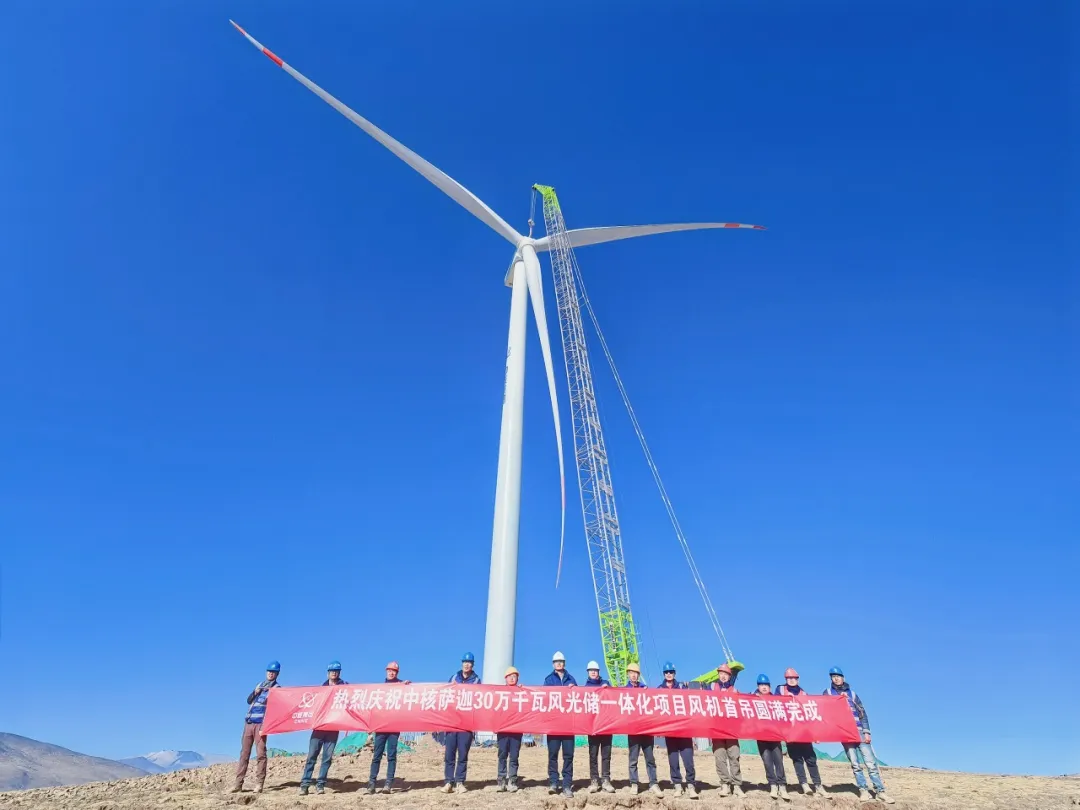
On April 20th, in the mountainous region of Saga County, Shigatse City, Tibet Autonomous Region, the first wind turbine of China National Nuclear Corporation's (CNNC) wind-solar integrated project in Tibet-known as the CNNC Saga 300,000-kilowatt Wind-Solar Integrated Project-was successfully installed. Calculations show that the highest altitude within the wind farm area reaches 5193 meters, making it the world's tallest altitude and largest single-unit wind power project currently under construction.
Located at the northern foothills of the Himalayas, approximately 140 kilometers from Mount Everest, the project has a total installed capacity of 300 MW. Of this, 200 MW is dedicated to wind power, with a total of 40 wind turbine units installed, each with a capacity of 5 MW. The individual wind turbine features a rotor diameter of 183 meters, a blade length of 90.1 meters, a hub height of 105 meters, and a total weight of 483.9 tons. During normal operation, a single wind turbine can produce approximately 3 kilowatt-hours of electricity per rotation, generating 5000 kilowatt-hours in one hour. This output is sufficient to meet the annual electricity needs of four ordinary households. Once completed, the project is expected to generate nearly 600 million kilowatt-hours of electricity annually, equivalent to saving approximately 164,200 tons of standard coal consumption, reducing sulfur dioxide emissions by approximately 453,400 tons, and cutting carbon dioxide emissions by approximately 450,100 tons. It will effectively promote high-quality economic and social development in the local area.