
In the underground utility tunnel of Xujiahui, Shanghai, lies a 1.2-kilometer-long 35 kV superconducting power cable. This demonstration line, located in the central area of Xuhui District in Shanghai and spanning 1.2 kilometers, boasts a 100% localization rate of core technology in China, setting numerous world records: the longest transmission distance, the most joints, and the largest transmission capacity for a commercial superconducting power transmission project. It is also the world's first kilometer-level superconducting power transmission project to supply power to an urban load center and the only one in the world to use full-length pipe jacking for installation.
As the world's first 35 kV kilometer-level superconducting power transmission demonstration project, since its official operation, the line has been running safely and stably for over 700 days. It has supplied 320 million kWh of electricity to 46,000 households in core areas like the Xujiahui business district in Xuhui District, setting a precedent for kilometer-level superconducting cables operating in the core areas of a large city. Recently, the project successfully achieved full-capacity operation, breaking the record for the largest actual operating capacity of a global commercial superconducting power transmission project.
Compared to traditional cables, what are the advantages of superconducting cables? What challenges were encountered during the development process, and how did the researchers overcome them step by step? As we face the peak demand of winter, what challenges does this power transmission line face? Join our reporter for an in-depth exploration.
High-Temperature Superconducting Cables Are Not High in Temperature
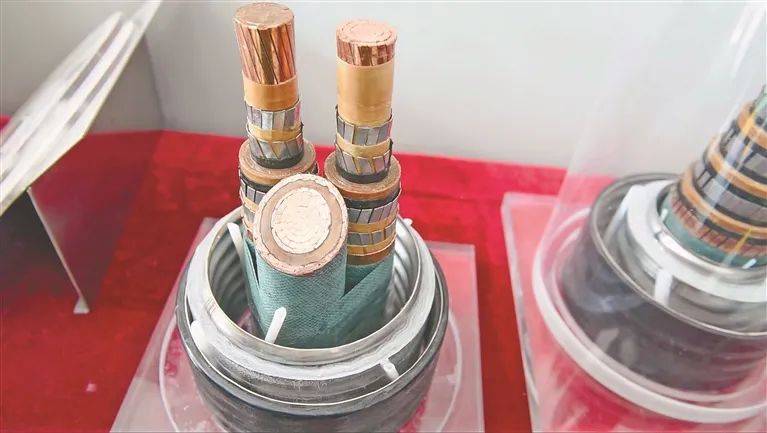
A single "strongest cable in history" is comparable to four to six traditional cables.
As December arrives, Shanghai is about to enter the coldest two to three months of the year, making peak demand and winter supply a top priority for the energy and power industry.
Beneath his feet lies an extremely cold world at -196°C.
This is the inlet end of the world's first 35 kV kilometer-level superconducting power transmission demonstration project.
It is understood that the transmission medium in traditional cables is usually composed of copper and aluminum alloy conductors, which have a certain resistance, resulting in corresponding energy loss during power transmission. In contrast, superconducting power transmission utilizes the superconducting properties of superconducting materials, making the power transmission medium close to zero resistance. Accordingly, the energy transmission loss approaches zero, achieving large-capacity transmission at low voltage levels, or "narrow channel, large capacity."
At a design voltage of 35 kV, a single superconducting cable can transmit a large current of over 2000 amperes. "This is equivalent to four to six traditional cables of the same voltage level. While meeting power supply needs, it can reduce the use of high-voltage cables in urban power grids, simplify the grid structure, and save space," Zong Ming explained. It is precise because of its small size, lightweight, large transmission capacity, low energy loss, and environmental friendliness that superconducting power transmission is considered one of the most revolutionary frontier technologies in the power industry today, and superconducting cables are known as the "strongest cables in history."
However, superconducting materials have their critical temperature, and only below this temperature can a superconductor be formed. The core material of the superconducting cable used in this demonstration project is the second-generation high-temperature superconducting tape material independently developed by China.
"Although it is called 'high-temperature superconducting,' the actual temperature is not high; it must be maintained in an environment below -196°C to sustain its superconducting state," Zong Ming further explained. As early as 1911, Dutch scientists discovered that when the temperature dropped below -268.95°C, the resistance of mercury suddenly dropped to zero, showing a superconducting state. Later, it was found that different materials have different superconducting critical temperatures. To make superconducting materials more practical, scientists began to explore high-temperature superconductors, once raising the critical temperature of superconductors to -183°C. The critical temperature of the second-generation high-temperature superconducting tape material used in the 35 kV kilometer-level superconducting power transmission demonstration project is -196°C, which is also the temperature of liquid nitrogen.
One of the challenges of the superconducting power transmission project is how to maintain the superconducting state of the cable, that is, how to keep the transmission medium in the cable at or below its critical temperature. "Therefore, researchers have found a way to wrap the cable in liquid nitrogen," Zong Ming said. The unique cable structure design solved this problem. If you cut open this superconducting cable, you will see an original structure similar to a "tricolor ballpoint pen"-the outer double-layer flexible vacuum insulation tube wraps around three mutually insulated superconducting cable cores, like three "pen refills," used to transmit three-phase alternating current. During operation, the "tricolor ballpoint pen" is filled with liquid nitrogen, and with the support of the cooling system, the entire transmission line is always maintained at the critical temperature of -196°C.