New York State Governor Kathy Hochul announced that the first operational wind turbine of the South Fork Wind Farm has successfully delivered clean electricity to Long Island. This marks a historic milestone as the first utility-scale offshore wind farm in U.S. federal waters begins "power generation."
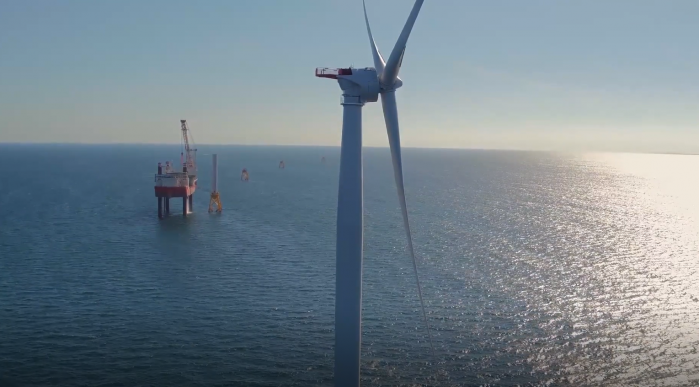
Two turbines have been installed, with one operational approximately 35 miles from Montauk, and all 12 turbines are expected to be installed by early 2024. The announcement aids in achieving the goal set by the U.S. Climate Leadership and Community Protection Act to install 9 gigawatts of offshore wind power by 2035.
Two weeks after the installation of New York's first offshore wind turbine, a milestone event was celebrated in East Hampton with joint venture partners Ørsted and Eversource, state, county, and local officials, advocates, and community members. Once completed, the South Fork Wind Farm will generate about 130 megawatts of renewable energy, enough to power approximately 70,000 Long Island homes. The renewable energy from the South Fork Wind Farm will reduce carbon emissions by up to 6 million tons annually, equivalent to taking 60,000 cars off the road.
The South Fork Wind Farm was first approved by the LIPA Board in 2017 and began construction in February 2022, starting with the onshore outlet cable system connecting the project to the LIPA grid, which was completed earlier this year. In June 2023, the wind farm reached the "steel in water" milestone with the installation of the project's first monopile foundation. Van Oord's offshore installation vessel Aeolus is installing the turbines.
The South Fork Wind project includes the first offshore wind substation built in the U.S. Over 350 American workers from three states supported the construction of the offshore substation, a topside structure that collects electricity generated by the wind turbines and connects it to the grid. New York's union workers supported the installation of the offshore substation.
Long Island-based contractor Haugland Energy Group LLC (a subsidiary of Haugland Group LLC) installed the underground duct bank system for South Fork Wind's onshore transmission lines and led the construction of the project's onshore interconnection facilities. LS Cable Company installed and connected the onshore cables with support from Long Island's Elecnor Hawkeye Company. The onshore cable project alone created over 100 union jobs for Long Island's technical workers. Also located on Long Island, Roman Stone Company manufactured the concrete mattresses that protect the submarine cables, while Ljungstrom in western New York collaborated with Riggs Distler & Company to provide specialized steel structural engineering.
Earlier this month, the Governor of New York announced the largest state renewable energy investment project in U.S. history. Conditionally awarded projects include three offshore wind projects and 22 onshore renewable energy projects, totaling 6.4 gigawatts of clean energy, sufficient to power 2.6 million New York homes and meet about 12% of New York State's electricity needs upon completion. Along with two large offshore wind blade and nacelle manufacturing facilities, the newly announced project portfolio is expected to create about 8,300 family-sustaining jobs and drive $20 billion in economic development investment statewide, including developer commitments to invest in supporting underserved communities.
New York's leading climate agenda calls for an orderly, just transition, creating family-sustaining jobs, continuing to drive the green economy across all sectors, and ensuring that at least 35% (with a goal of 40%) of clean energy investment benefits are directed to underserved communities. Guided by some of the most aggressive climate and clean energy initiatives in the U.S., New York is on the path to achieving zero emissions in the electricity sector by 2040, including 70% renewable energy generation by 2030 and carbon neutrality across the entire economy by mid-century. The cornerstone of this transition is New York's unprecedented clean energy investment, including over $55 billion invested in 145 large-scale renewable energy and transmission projects statewide, as well as $6.8 billion for reducing building emissions, $3.3 billion to expand solar scale, nearly $3 billion for clean transportation programs, and over $2 billion in commitments from the New York Green Bank. These investments and others will provide over 165,000 jobs in New York's clean energy industry by 2021, with the distributed solar industry growing over 3000% since 2011. To reduce greenhouse gas emissions and improve air quality, New York has also passed zero-emission vehicle regulations, including a requirement that all new passenger cars and light trucks sold in the state be zero-emissioned by 2035. Partnerships have been established with nearly 400 registered and over 100 certified climate-smart communities, nearly 500 clean energy communities, and the largest community air monitoring program in 10 disadvantaged communities statewide to help address air pollution and climate change issues, further advancing New York's climate action.