
Armored fiber cable is a type of optical cable that has a protective "armor" (stainless steel armor tube) wrapped around the fiber core. This stainless steel armor effectively protects the fiber core from animal bites, moisture erosion, or other damage. In short, armored fiber cable not only possesses the characteristics of standard optical cable but also provides additional protection for the fiber, making it more robust, reliable, and durable. Nowadays, armored fiber cable is the preferred choice for campus networks, data centers, and industrial applications.

Construction of Armored Fiber Cable Outer Jacket: In the design of armored fiber cable, the outer jacket protects the cable from damage by solvents and abrasion. Typically, the outer jacket is made of plastic, such as polyethylene.
Metal Armor: Between the outer jacket and the inner jacket is the armored casing. This armor material is difficult to cut, bite, and burn, and it also prevents stretching of the cable during installation. As shown in the figure below, the 12-core armored fiber cable contains 12 fibers and two layers of jackets, inside and outside. The metal armor is located between the inner and outer jackets, with a layer of aramid yarn between the outer jacket and the metal armor.
Why Use Armored Fiber Cable? Previously, outdoor optical cables were typically laid in sturdy conduits to prevent damage from external forces. However, this method of laying cables is quite complex and costly in terms of time and labor. Therefore, a layer of metal armor was designed to be added inside the cable to protect the fiber core, known as armored fiber cable. Armored fiber cable has anti-compression and anti-tension capabilities, can withstand harsh outdoor environments, and offers much more flexible wiring than conduit wiring. Today, armored fiber cable is widely used in the field of optical communications.
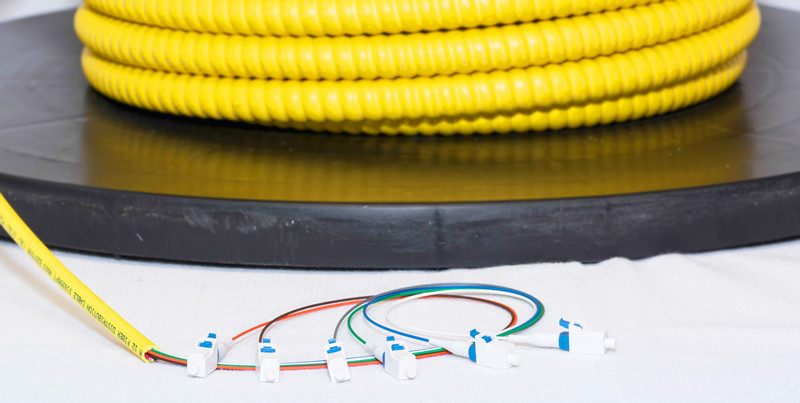
Types of Armored Fiber Cable Besides the commonly mentioned indoor and outdoor armored fiber cables, what other types of armored fiber cables are there? Armored fiber cables can be divided into several types based on different dimensions, as follows:
Classification by Application Armored fiber cables can be divided into indoor and outdoor armored fiber cables based on the application.
Indoor Armored Fiber Cable
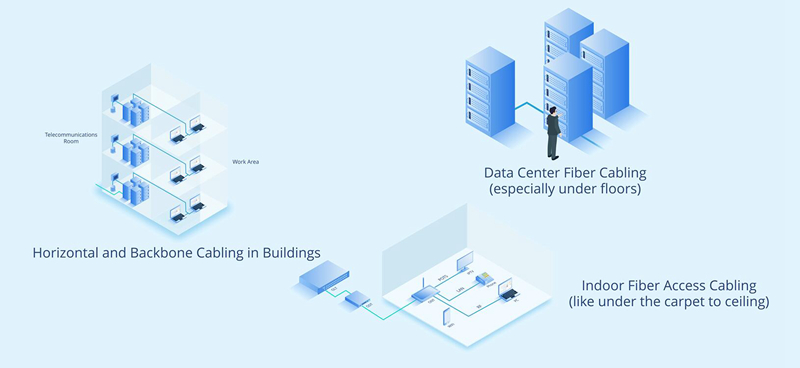
Indoor armored fiber cables typically consist of tight-buffered or loose-tube fibers with reinforcing components and an inner jacket, usually wrapped by a spiral-wound interlocking metal armor tube. Indoor armored fiber cables can be further divided into single-layer armored fiber cables (without stainless steel braided wire) and double-layer armored fiber cables (with stainless steel hose and braided wire), with the latter often used in extreme environments such as nearshore and shallow seas, while the former is used in other situations outside these extreme environments. With the rapid development of fiber optic communication technology and the trend of FTTX applications, the demand for indoor armored fiber cables is growing rapidly.
Outdoor Armored Fiber Cable
Outdoor armored fiber cables are designed to ensure safe operation in complex outdoor environments, with most outdoor cables being of loose-tube fiber structure. It is important to note that outdoor armored fiber cables can be divided into light armored fiber cables and heavy armored fiber cables. Lightly armored fiber cables have a protective plastic jacket with the same durability and lifespan as stainless steel cables but are lighter and suitable for most applications in industrial and semi-harsh environments, serving to enhance protection and prevent rodent bites. Heavy armored fiber cables are wrapped with a circle of steel wire on the outside, protecting the fiber from animal bites and damage during direct burial installation, suitable for riverbeds and seabeds with strong waterproof capabilities.

Classification by Metal Armor Type Additionally, armored fiber cables can also be divided into interlocked armored fiber cables and corrugated armored fiber cables based on the type of metal armor.
Interlocked armored fiber cables refer to aluminum spirally wound around the cable, commonly used in indoor and outdoor applications, with high durability and excellent compression resistance. Corrugated armored fiber cables refer to coated steel strips folded longitudinally around the cable, commonly used in outdoor applications, with superior mechanical performance and the ability to prevent rodent bites.
Both types of armored fiber cables can be applied in harsh outdoor environments with excessive dust or even damage caused by rodent bites.