
Category 5 (Cat5), Category 5e (Cat5e), and Category 6 (Cat6) Ethernet cables have been widely used in enterprise networks, data center networks, and home networks. As people's demand for networks grows, the types of Ethernet cables are also constantly being upgraded to meet different transmission distances and application requirements. For example, Cat5e Ethernet cable can support 1000base-T applications, with a transmission distance of up to 100m, which can fully meet the needs of various applications in homes, offices, and data centers. It has better performance than Cat5 Ethernet cable and a lower price than Cat6 Ethernet cable, these advantages make it one of the most widely used types of Ethernet cables.
Structure of Cat5e Ethernet Cable As shown in the figure below, Cat5e Ethernet cable is composed of copper conductors, a high-density polyethylene insulation layer, and an outer sheath. Each Cat5e Ethernet cable has four copper wires inside, and its tail is connected to the RJ45 connector (crystal head). Cat5e Ethernet cable has two types: straight-through and crossover, the difference between straight-through Ethernet cable and crossover Ethernet cable will be explained in detail below.

Connection Method of Cat5e Ethernet Cable For easy identification, each pair of copper wires in the Cat5e Ethernet cable has a specific color insulation layer, so during the wiring process, you must follow the standard color code of the Cat5e Ethernet cable to perform the wiring operation.
The wiring method for straight-through Ethernet cable has two standards approved by ANSI, TIA, and EIA: T568A standard and T568B standard. Although both standards can be used, the T568B standard is generally considered to be better than the T568A wiring standard. The figure below is a schematic diagram of the two wiring standards for the Cat5e Ethernet cable.

When wiring straight-through, the wire leads at both ends of the Cat5e Ethernet cable should be the same. However, for the crossover wiring method, the RJ45 leads at both ends of the Cat5e Ethernet cable are different. The figure below is a schematic diagram of the crossover end connection of 8 conductors.

If you want to terminate the Ethernet cable according to the T568A standard and T568B standard, you can use this crossover wiring method. The figure below shows the leads at both ends of the Cat5e Ethernet cable.

Wiring Process of Cat5e Ethernet Cable
Prepare a set of network tool kits Before performing the wiring operation, you must first prepare the Cat5e Ethernet cable. If conditions permit, you can also prepare a set of network tool kits in advance. It contains all the tools and parts that will be used during the wiring process, such as cable tester, RJ45 connector, RJ45 network module, punch down tool, Ethernet cable pliers, cable ties, diagonal pliers, storage bag, oil-based pen, etc., which can help you quickly perform Ethernet cable connection and network deployment.
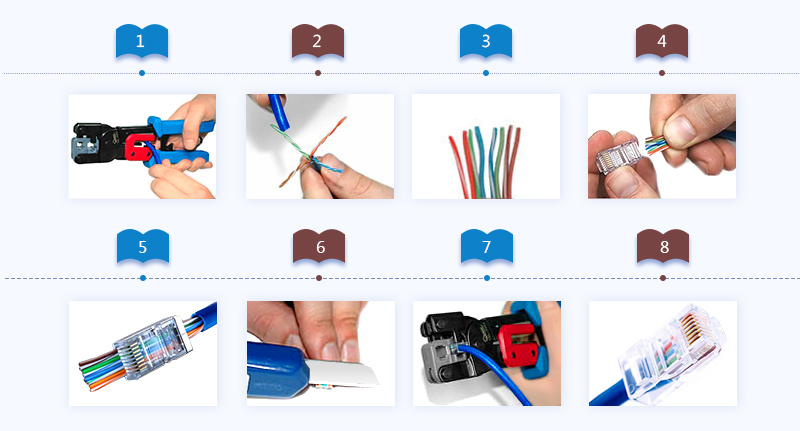
Perform termination operation Step 1. Cut the appropriate length of Cat5e Ethernet cable according to actual needs, and use a wire stripper to strip off the outer sheath. Step 2. Open the Cat5e Ethernet cable and trim the excess parts. Requirement: As flat as possible, otherwise it is difficult to accurately insert the connector. Step 3. According to the T568A or T568B wiring scheme, place the end of the Cat5e Ethernet cable from left to right. Step 4+Step 5. Insert the Cat5e Ethernet cable into the RJ45 connector. Note: Must be sorted in the same order as step 3. Step 6. Use a punch-down tool to cut off the excess wire. Step 7. Use a crimping tool to squeeze the plug. This step ensures a solid connection between the Cat5e Ethernet cable and the RJ45 connector. Step 8. Repeat the process at the other end, and test the Cat5e Ethernet cable. Ensure that the wire sequence at both ends of the Ethernet cable is accurate and can perform normal network communication.

Solution of Cat5e Ethernet Cable HKS-Cable provides a full set of network patch cord customization services, such as length, color, specifications, materials, packaging, etc. All Ethernet cables are strictly tested before leaving the factory to ensure smooth connection. From design to mold opening, and then to material selection, every step shows the intention. Incoming material quality inspection, processing production, finished product quality inspection, packaging quality inspection, and other strict quality inspection assessments, comply with TIA/EIA-568B or TIA 568A wiring standards, present excellent quality for you, the following are more advantages of HKS-Cable Cat5e Ethernet cable.
High-quality PVC/LSZH material + selection of high-quality environmentally friendly materials HKS-Cable network patch cord uses high-quality and environmentally friendly PVC/LSZH outer sheath + PE insulation material, with excellent tensile strength, strong environmental protection, strong wear resistance and oxidation resistance, and also has good electrical insulation and corrosion resistance, more durable than ordinary Cat5e Ethernet cable.
Ultra-fast transmission + gold-plated reed design Low-resistance oxygen-free copper conductor core: It can support a transmission speed of up to 10G Ethernet, which is faster and more stable than the transmission of ordinary Cat5e Ethernet cable.
Gold-plated reed design: The RJ45 connector adopts a 50μm gold-plated design, which has good contact and transmission performance, strong oxidation resistance, and does not rust or turn black, truly achieving high-quality transmission.
In conclusion, Cat5e Ethernet cable can be used for network connection, wiring engineering, device interconnection or horizontal subsystem termination, and connection between device port and modular patch cord system, such as: connecting telecom broadband ADSL MODEM, and wireless router, switch, hub, firewall and other equipment's LAN interface to the computer's network card interface, etc. In addition, it also has shielded and unshielded, card slot design, tailless sleeve design, retractable design, and LSZH, PVC/OFNR, and other types, you can also choose the appropriate meter number according to application needs or customize the Ethernet cable that meets your needs.