
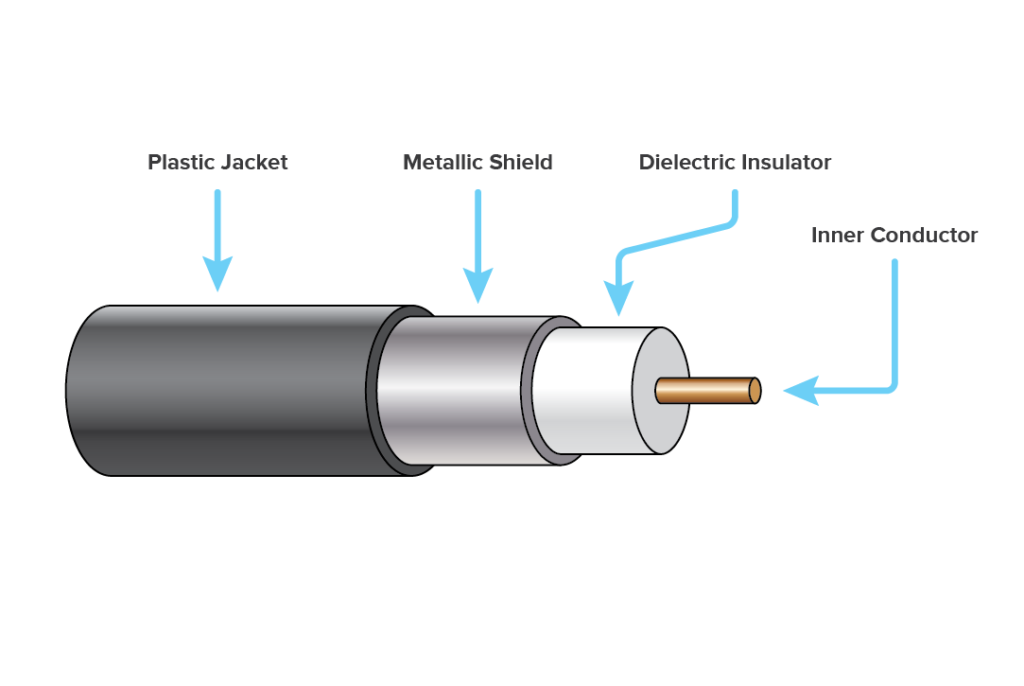
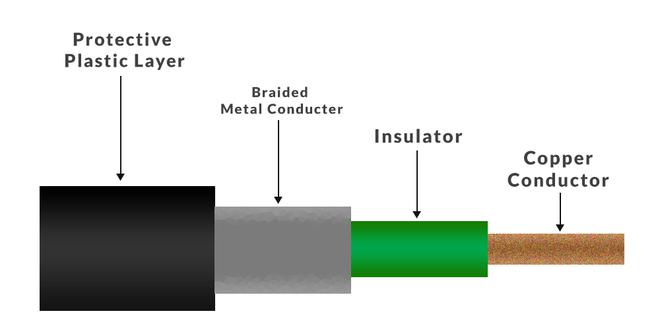
Coaxial cable is a type of cable that consists of two or more conductors arranged concentrically, with a common axis. The center conductor is responsible for carrying the signal, while the outer conductor provides a shield against interference.
Coaxial cables are commonly used in a variety of applications, including:
Cable television: Coaxial cables are used to transmit television signals to homes and businesses.
Coaxial cable used in cable television
Broadcasting: Coaxial cables are used to transmit radio and television signals from broadcast stations to antennas.

The coaxial cable used in broadcasting
Computer networking: Coaxial cables are used to connect computers in local area networks (LANs).
Coaxial cable used in computer networking
Satellite television: Coaxial cables are used to transmit satellite television signals from satellites to homes and businesses.

Coaxial cable used in satellite television
Coaxial cables are available in a variety of sizes, with different impedances and bandwidths. The impedance of a coaxial cable is a measure of its resistance to signal reflection, while the bandwidth is a measure of the range of frequencies that can be carried by the cable.
Coaxial cables are typically made of copper or aluminum, with plastic or rubber insulation. The outer conductor is often made of a braided metal shield.
The advantages of coaxial cables include:
Good shielding against interference: Coaxial cables are well-shielded against interference from other electrical devices and signals.
High transmission speed: Coaxial cables can carry signals at high speeds over long distances.
Reliable performance: Coaxial cables are generally reliable and can withstand a wide range of environmental conditions.
The disadvantages of coaxial cables include:
Cost: Coaxial cables can be more expensive than other types of cables.
Flexibility: Coaxial cables can be less flexible than other types of cables.
Weight: Coaxial cables can be heavier than other types of cables.